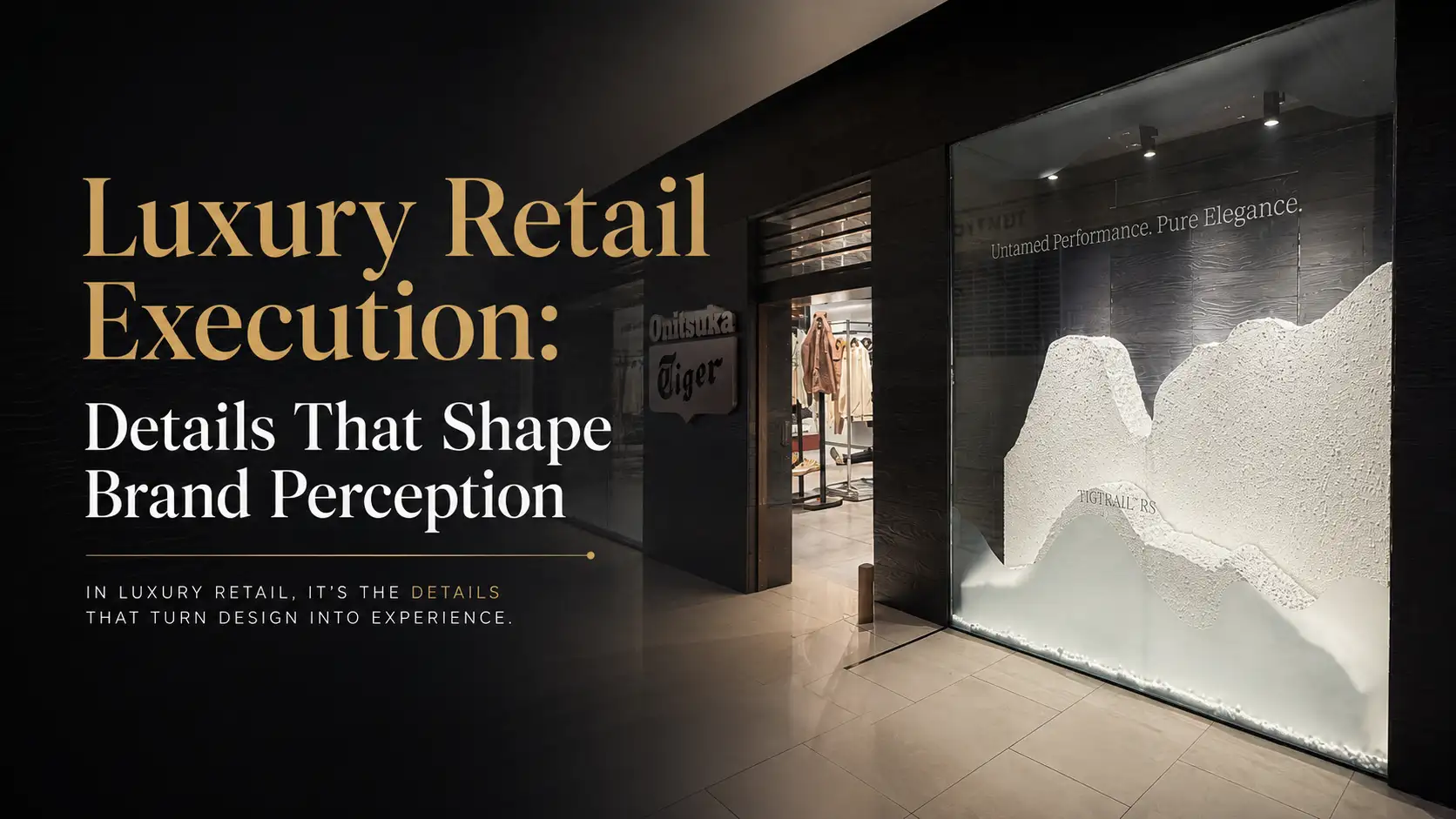
A retail campaign can start with a strong concept, a polished key visual and a clear marketing plan. But once the campaign moves into physical execution, the most important question is no longer “Is the design ready?”
It is: “Do we have enough time to turn that design into reality by launch day?”
A retail campaign can involve window displays, in-store visuals, POSM, signage, lightboxes, custom fabrication, lighting, logistics and installation. Each item has a different lead time, and many tasks cannot start until earlier decisions are locked. That is why an effective retail campaign timeline should not be just a list of tasks. It should work as an execution system — with the launch date as the fixed point and every key milestone planned backward from it.
Here are five practical steps we use as a foundation for campaigns with physical execution.
01. Start With the Launch Date
The first mistake in campaign planning is starting with “design start.” A better timeline starts with the date the campaign must be live in-store.
Set the Go-Live Date or Installation Date first. Then work backward to determine when production must finish, when artwork must be approved, when materials need to be ordered and when technical drawings must be released.

For example, if a campaign must be installed by November 30, production cannot simply start a few days before. Before fabrication begins, the project may require material selection, technical development, color proofing, fabrication, finishing, QC, packing and transportation.
A basic campaign framework could look like this:
W-6: Brief, guideline review and site information
W-5: Design adaptation and technical development
W-4: Final artwork, material confirmation and approval
W-3: PO and production release
W-2: Main production and fabrication
W-1: QC, packing and logistics
W-0: Installation and final inspection
This is only a reference framework. Campaigns with custom fabrication, lighting, specialty materials or multiple locations will require more time.
The key principle is simple:
The launch date is fixed. Everything else works backward from it.
02. Break the Campaign Into Workstreams
A campaign may look simple on a brief, but physical execution usually involves several workstreams running in parallel.
A window display, for example, may include:
- Creative / Design: artwork, 3D and visual adaptation
- Technical: dimensions, construction details and material specifications
- Production: printing, fabrication and finishing
- Lighting: fixture selection, wiring and testing
- Logistics: packing, transportation and delivery
- Installation: dismantling, installation, alignment and detailing

A single task list can hide important dependencies. Production does not always have to wait until every design detail is completed. Once the direction is clear enough, technical discussions, material sampling and production feasibility checks can begin in parallel.
This is also how Golden Point structures its execution process: Concept → Technical → Production → Installation → Experience. Each stage has a clear role, but all stages remain connected.
A strong timeline should answer three questions:
- What depends on what?
- What can run in parallel?
- What sits on the critical path?
Good campaign planning is less about creating more tasks and more about identifying the right dependencies.
03. Identify Long-Lead Items Early
The design is not always what makes a campaign late. Very often, delays come from a special material, an imported lighting fixture, custom hardware, a custom structure or a fabrication process that takes longer than expected. That is why Long-Lead Items need to be identified early. Long-lead items are materials, equipment or components that require more time for sourcing, approval, production or shipping than standard items.

Typical examples include specialty lighting, custom metal structures, custom woodwork, imported hardware, special finishes, lightbox components and made-to-order materials.
Golden Point’s Dior luxury window display, for example, combined double-sided printing, concealed support structures and more than 1,000 micro lighting points within a published three-week timeline. A Prada project also included lightboxes, CNC-carved wood panels, leather-wrapped display elements, metal details, crystal embellishments and multiple rounds of lighting and material testing, with a published three-week timeline.
This is why every campaign should have a simple long-lead tracker:
Item → Specification → Supplier → Lead Time → Approval Date → PO Date → Required on Site
A basic rule is:
Do not wait for production to tell you that an item is late. Identify the risk before production starts.
When an item has a long lead time, it should enter the timeline early — even when the final artwork is still being developed.
04. Treat Approval as a Hard Deadline
One of the most common reasons campaigns slip is approval. A design may be completed on time, but production still cannot move because the final color, material, dimensions or artwork has not been approved. The problem is not production. The problem is that approval was treated as a soft task instead of a hard deadline. This becomes even more important when working with global brand guidelines.

Onitsuka Tiger Vietnam is a good example. Its VM rollouts require close alignment with international brand standards, seasonal color accuracy and consistent execution across campaigns. Golden Point supports the production and execution of window displays and POSM based on these seasonal guidelines.
In this type of campaign, approval may include:
- Artwork approval
- Color approval
- Material approval
- Technical approval
- Final production approval
Each approval can unlock the next stage.
For example:
- Color not approved → Printing cannot start
- Material not approved → Fabrication cannot start
- Technical drawing not approved → Production release is delayed
- Final artwork not approved → Installation date becomes a risk
Instead of creating one generic “Client Approval” task, identify exactly which approval is required, by whom and what task depends on it.
A useful rule is:
Every approval should have a deadline, an owner and a downstream dependency.
That turns a timeline into more than a project tracking tool. It becomes a tool for managing decisions.
05. Build a Buffer
A “buffer” can be simply understood as a reserve period set aside to handle any issues that arise. A timeline with no buffer may look efficient in Excel, but it is often fragile in the real world. Production can finish on time and still face transport delays, site access issues, reprints, damaged components or unexpected site conditions. Luxury hoarding projects show this clearly.
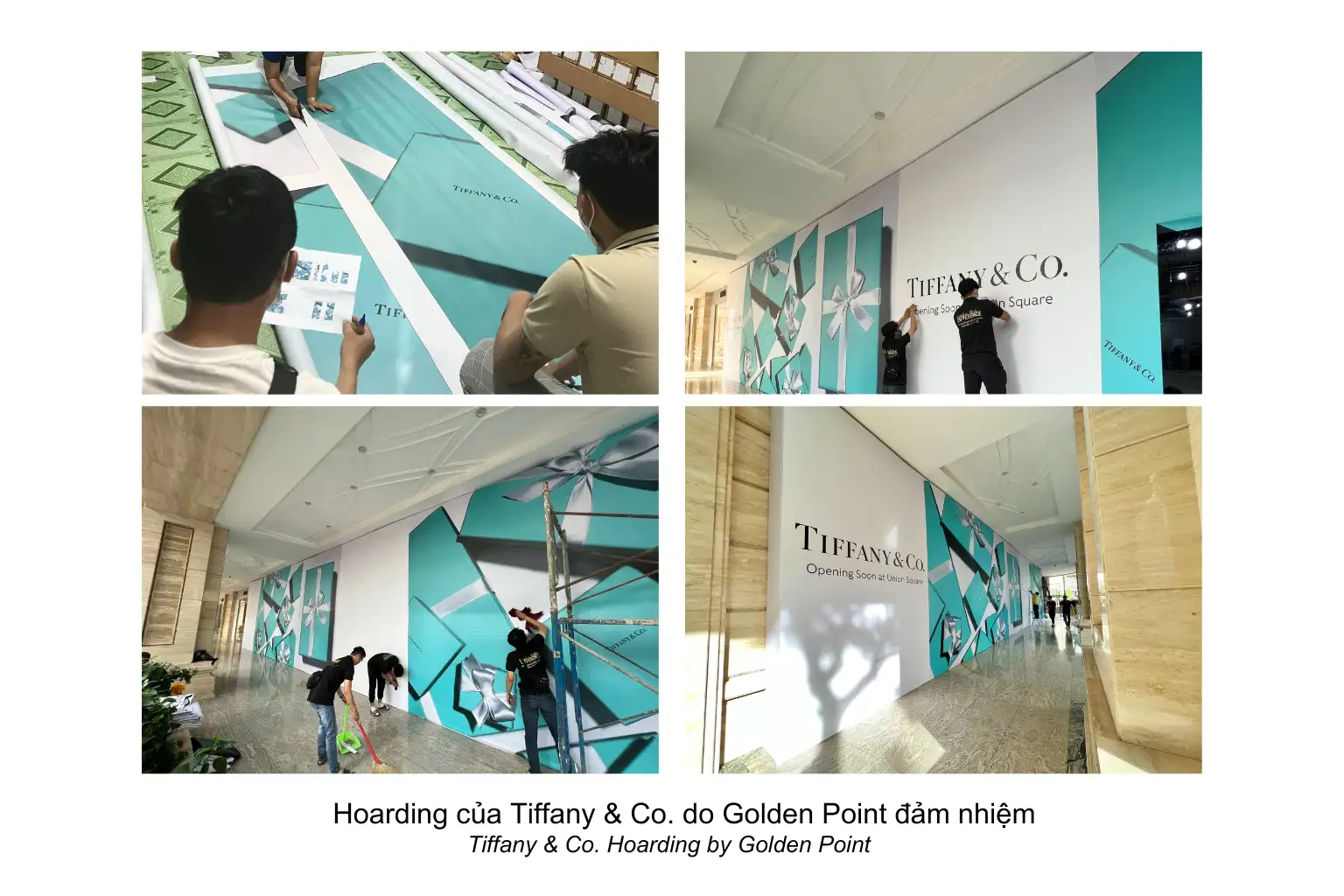
For Hermès and Tiffany & Co., Golden Point had to work with existing surfaces that were not suitable for direct application, while also maintaining strict color accuracy and luxury-level finishing. Surface preparation, testing and precise installation therefore had to be part of the execution timeline rather than being treated as last-minute installation work.
Buffer should be considered around the highest-risk points:
- Approval buffer
For client feedback and revisions. - Production buffer
For custom fabrication, printing and finishing. - Logistics buffer
For transportation, delivery and site access. - Installation buffer
For adjustment, rework and unexpected site conditions.
Not every project needs the same amount of buffer. A simple graphic rollout may need less than a custom window display with structural and lighting elements. But the principle is the same:
A campaign should be finished before the launch date — not on the launch date.
What Should a Good Retail Campaign Timeline Look Like?

A good timeline does not need hundreds of tasks. It needs the critical milestones to be visible. A campaign can be grouped into six simple stages:
01 — Brief & Direction
Campaign brief, objectives, global guidelines and launch date.
02 — Design & Technical
Artwork adaptation, 3D, dimensions, materials and technical drawings.
03 — Approval
Artwork, color, material and technical approval.
04 — Production
Printing, fabrication, finishing, lighting preparation and pre-assembly.
05 — Logistics & Installation
Packing, transportation, site preparation, installation and alignment.
06 — Final QC & Launch Readiness
Final inspection, punch list, corrections and handover.
This structure keeps the campaign visible without turning the timeline into a spreadsheet full of disconnected tasks. At the execution level, one principle is especially useful:
Do not plan every task first. Plan every decision first.
In physical campaigns, a delayed decision today can become a production delay several days later — and eventually affect launch.
What Happens When Planning Starts Too Late?
A campaign usually does not become late on installation day. It becomes late much earlier.
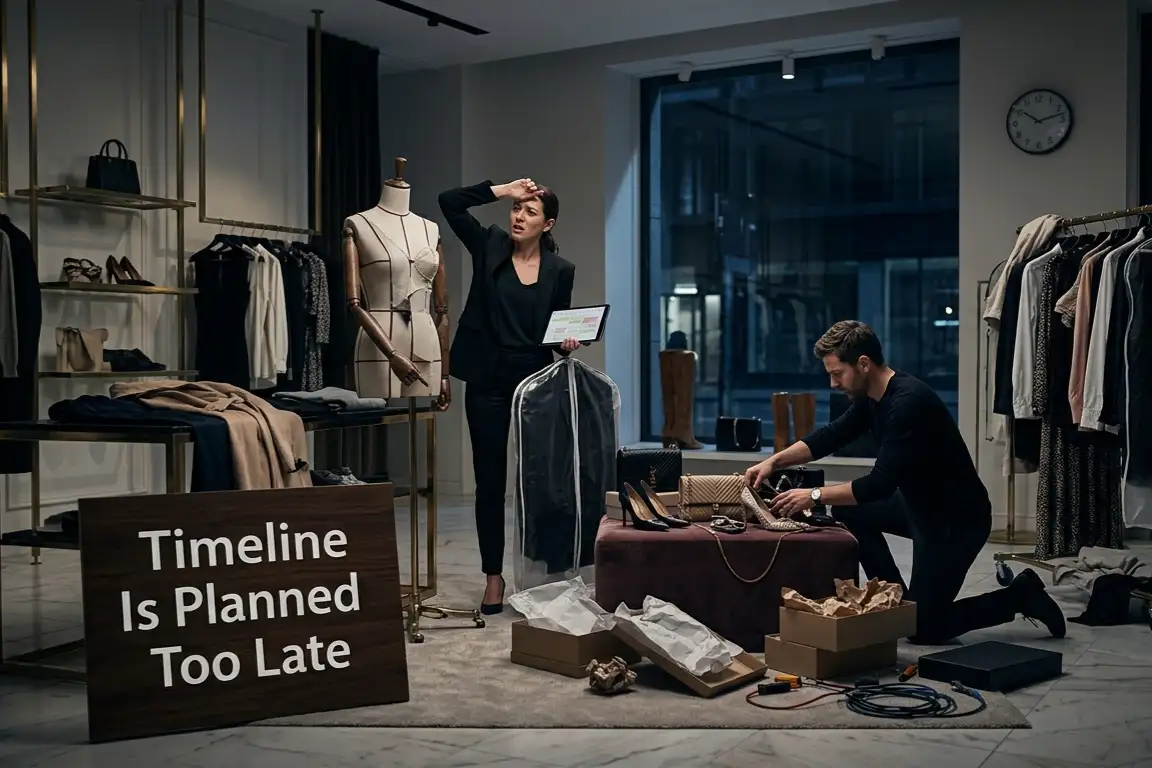
A two-day delay in artwork approval can create a two-day production delay. Production then pushes logistics. Installation time gets shorter. QC gets compressed. The team ends up working harder simply to reach the original launch date.
That is why two campaigns with the same deadline can feel completely different. Campaign A starts planning early, identifies long-lead items, locks approval milestones and keeps a buffer. Campaign B starts production planning when the design is almost finished. Both have the same launch date. Only one has a timeline designed for controlled execution.
From Campaign Calendar to Execution System
Effective retail campaign planning is not about creating a beautiful timeline in Excel. It is about seeing the full chain behind launch day: design, approval, materials, production, logistics, installation and final quality. For campaigns involving custom fabrication, lighting, specialty materials or multiple locations, the timeline should be built around the critical path rather than a simple task list.

At Golden Point, we see execution as one connected flow: Concept → Technical → Production → Installation → Experience. The goal is not simply to complete each task, but to make sure the full campaign reaches launch with the timing, quality and brand intent under control. Because in Visual Merchandising, a campaign is only successful when the idea appears in the right place, at the right time and exactly as the brand intended customers to see it.
--> Explore Golden Point Projects
--> Explore Production & Fabrication
Golden Point
Brand Experience | Visual Merchandising | Production | Installation